1000 Bestseller Strategy Prompts: What It Is and How to Use It
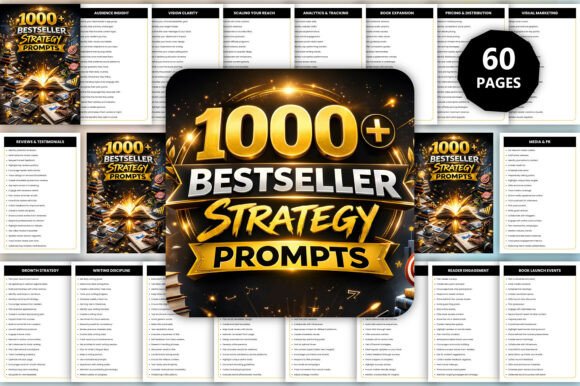
If you have ever set out to write a book, you know the process involves more than just putting words on a page. From finding a viable idea to building an audience and launching successfully, each step demands strategy. That is where 1000 Bestseller Strategy Prompts comes in. It is a structured digital playbook designed to guide authors, self-publishers, and content entrepreneurs through every stage of creating a book that not only sells but also builds long-term authority. Unlike a simple list of writing prompts, this system covers idea validation, audience research, content structuring, marketing, monetization, and distribution—all in one actionable format.
The resource comes as both high-quality PDF files suitable for professional printing and JPG images for quick reference. Whether you are working on a nonfiction guide, a novel, or a business book, the prompts help you move from vague ambition to a concrete plan. But what makes this tool truly valuable is how it adapts to different users.
Why Different Readers Find Value in This System
Not everyone approaches a publishing project with the same background or the same goals. Some people are just starting out, others have published multiple books and want to refine their process. The beauty of 1000 Bestseller Strategy Prompts is that it can serve both extremes, as well as everyone in between. Here is how various types of users might interact with it.
Beginners Looking for a Clear Roadmap
If you have never written a book before, the sheer number of decisions can feel overwhelming. Do you start with a title or a chapter outline? How do you know if anyone will want to read your book? For a beginner, the prompts act as a checklist. You can work through them one by one, building confidence with each completed step. For example, the vision and audience clarity section includes prompts that ask you to define your book’s purpose and ideal reader. This forces you to think about your niche before you write a single word, saving time and frustration later.
A beginner might also appreciate the marketing preparation prompts. Instead of worrying about social media promotion after the book is done, you are guided to set up a pre-launch email campaign and an influencer outreach list early. This gradual approach makes the entire process feel manageable.
Experienced Authors and Self-Publishers
For those who have already published one or more books, the system offers a way to fill gaps. Maybe you have a strong content creation process but lack a solid launch strategy. Or perhaps your books sell okay but you want to build recurring income through upsells and subscription models. The sales funnel and monetization section provides prompts specifically for setting up bonus offers, affiliate programs, and tiered pricing. An experienced author could use these prompts to retrofit an existing book with a stronger backend offer.
Another priority for seasoned users is speed. You do not need to reinvent the wheel. The content blueprint writing system includes prompts for outlining chapters and structuring nonfiction frameworks. If you have a rough draft, you can skip the idea validation prompts and jump straight to the marketing analytics section, where prompts help you review your sales data and plan expansion to new platforms.
Content Entrepreneurs and Bloggers
If you run a blog, YouTube channel, or online course, you understand the power of intellectual property. A book can be a central asset that ties your content together. For a content entrepreneur, 1000 Bestseller Strategy Prompts is less about writing a single book and more about building an ecosystem. The monetization funnels section is especially useful. It includes prompts for designing a book funnel that leads to higher-tier offers, such as coaching or membership programs.
You might use the title and hook positioning strategy to test messaging across your existing audience. For example, you could run a poll using one of the subtitle prompts, see which variant gets the most engagement, and then use that data to finalize your cover. The system also covers distribution platform growth, which helps you optimize metadata and pricing across Amazon, your own site, and international retailers.
Educators and Trainers
If you teach a subject or run workshops, a book can be both a teaching tool and a credential. Educators often focus on credibility and structure. The authority-building prompts in the vision clarity section help you define your unique angle and competitive edge. You can then use the chapter outlining prompts to create a logical progression that aligns with your curriculum.
What about long-term usefulness? An educator might use the system to plan a series of books or workbooks. The expansion planning prompts guide you to consider translation, audiobook production, and companion courses. This way, a single project can become a library of resources that serve students for years.
Small Business Owners and Professionals
Publishing a book can establish you as an expert in your field, open speaking opportunities, and even generate leads. For a business owner, the cost of hiring a ghostwriter or editor is significant, so doing the strategic work yourself can save money. The ease of use here is key. You do not need to be a writer; you need to answer prompts about your expertise and audience. The system handles the structure so you can focus on content.
For example, a marketing consultant could use the competitive edge prompts to analyze what competitors’ books lack, then fill that gap with their own. The launch event planning prompts also apply to business contexts—hosting a webinar or a live Q&A as part of the launch can double as a lead generation event.
Hobbyists and Lifelong Learners
Not everyone writes for commercial success. Some people write to preserve family history, share a personal journey, or just enjoy the creative process. Even for these users, the system offers value. The writing discipline prompts help maintain consistency. The content blueprint section can turn a collection of memories into a coherent narrative. And while monetization might not be a priority, the branding and presentation prompts ensure the final book looks professional, which adds to personal satisfaction.
How to Decide If This System Fits Your Goals
With so many possible use cases, how do you know if 1000 Bestseller Strategy Prompts is right for you? The answer depends on your current stage, your primary need, and how you prefer to work.
- If you value structure over creativity. The prompts are designed to lead you through a logical sequence. If you like having a clear next step, this will feel supportive. If you prefer total freedom and improvisation, it might feel restrictive. Consider using only the sections that match your working style.
- If your priority is low cost with high information density. Compared to hiring a book coach or buying multiple separate courses, a single digital pack of prompts is inexpensive. But you need to be willing to invest your own time to work through them. The quality lies in the comprehensiveness, not in glossy production values.
- If you need flexibility for different types of books. The system covers both fiction and nonfiction, but the emphasis is heavily on nonfiction, business, and self-help. Fiction authors will find value in the story arc prompts, but the marketing and monetization sections are more generic. Evaluate whether the prompts align with your genre.
- If you are optimizing for commercial value. The sales funnel, launch, and analytics sections are the strongest assets. If your main goal is to sell many copies and build a brand, you will benefit most from those parts. If your goal is purely creative expression, you might skip large portions.
- If you prefer visual and PDF formats. The included JPGs are useful for brainstorming on a tablet or printing a single prompt to focus on. The PDFs are presentation-ready. If you are someone who likes to mark up documents or keep a physical binder, this is convenient.
- If you value long-term usefulness. Because the prompts are evergreen (they focus on strategy rather than trendy tactics), you can reuse them for multiple projects. An author who plans to write a series of books can go back to the audience research and expansion prompts each time.
Practical Examples for Different Reader Types
To make this more concrete, here are three short scenarios.
A beginner: Sarah wants to write a cookbook but has never published anything. She starts with the vision clarity prompts and realizes she needs to define whether her book is for busy parents or health-conscious professionals. She then uses the content blueprint prompts to outline 50 recipes and structure the chapters by meal type. The marketing prompts guide her to build a small email list before the launch. Six months later, she has a well-positioned book and a modest but engaged audience.
An experienced author: Marcus has self-published two novels. Sales have plateaued. He uses 1000 Bestseller Strategy Prompts to analyze his previous launches. The analytics prompts show him that his pricing strategy was inconsistent and his metadata lacked keywords. He reworks his Amazon listings using the distribution prompts and creates a bonus short story as a lead magnet. Within two months, his existing books see a 30% increase in organic visibility.
A content entrepreneur: Priya runs a popular YouTube channel about minimalism. She uses the title and hook prompts to come up with a working title that resonates with her viewers. The launch campaign prompts help her coordinate a video series that builds anticipation. After the book launch, she uses the monetization prompts to create a paid worksheet bundle. The book becomes a top seller in its category, and the bundle generates ongoing passive income.
What to Keep in Mind
1000 Bestseller Strategy Prompts is a tool, not a magic wand. It will not write your book or market it for you. What it does is remove the guesswork from the planning and execution stages. You still need to show up and do the work. But if you are looking for a structured, comprehensive, and reusable system that covers idea validation all the way through to expansion, this playbook provides the scaffolding.
Before investing, reflect on your own priorities. Do you need help with creativity or commercial strategy? Are you comfortable working from prompts, or do you require more hand-holding? The resource is best for self-starters who appreciate a clear guide but are willing to take action. If that sounds like you, then exploring what this system offers could be the next step in your publishing journey.