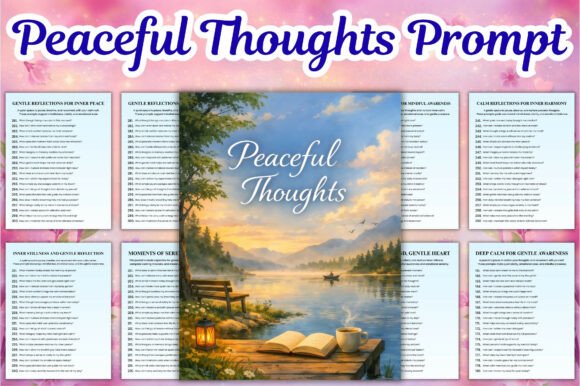
Peaceful Thoughts Prompts: A Guide to Calm Reflection and Mindful Living
In an era of constant notifications, endless to-do lists, and the hum of digital noise, finding a moment of genuine quiet can feel like a luxury. Yet the human mind craves stillness—a space to breathe, to process, to simply be. This is where the practice of using peaceful thoughts prompts comes in. These carefully crafted questions and reflection cues are not just journaling tools; they are invitations to slow down, untangle your thoughts, and reconnect with a sense of inner calm. Whether you are new to mindfulness or a seasoned journaler, understanding what these prompts are, why they work, and how to integrate them into your daily life can transform your mental and emotional landscape.
What Are Peaceful Thoughts Prompts?
At their core, peaceful thoughts prompts are gentle, open-ended questions or statements designed to guide your mind toward reflection without pressure or judgment. Unlike traditional journaling prompts that might ask you to solve a problem or set a goal, these prompts focus on creating a quiet, safe space for emotional exploration. They often revolve around themes like gratitude, mindfulness, self-compassion, emotional balance, and positive thinking. For example, a prompt might ask, “What is one small thing that brought you peace today?” or “Describe a moment when you felt completely at ease.”
These prompts are not about productivity or achievement. They are about presence—the act of being fully engaged with the here and now. Many people use them as part of a morning or evening routine, but they can be accessed anytime you need a mental reset. The Peaceful Thoughts Prompt journal, for instance, offers 300 such prompts, each one designed to help you release mental stress, organize your thoughts, and cultivate a mindset of gentleness and clarity.
The Purpose and Significance of Guided Reflection
Why do we need prompts at all? Can’t we just sit quietly and reflect on our own? For many of us, the answer is no. The modern mind is trained to race, to plan, to worry. Without a gentle guide, quiet time can quickly turn into rumination or anxiety. Peaceful thoughts prompts serve as a rudder—they keep the mind from drifting into unproductive or distressing territory. Their purpose is twofold: to create structure without rigidity, and to invite depth without overwhelm.
The significance of this practice extends beyond mere relaxation. Neuroscientific research shows that reflective practices like journaling can lower cortisol levels, improve emotional regulation, and even strengthen the prefrontal cortex—the part of the brain responsible for decision-making and empathy. When you engage with prompts that encourage gratitude or self-awareness, you are literally rewiring your brain for positivity and calm. This is not just feel-good philosophy; it is grounded in neuroplasticity. Over time, regular use of peaceful prompts can shift your default mental state from stress to serenity.
Moreover, these prompts address a fundamental human need: the need to be heard—by yourself. In a world that often prioritizes external validation, taking time to acknowledge your own thoughts and feelings is a radical act of self-care. The prompts act as a non-judgmental companion, affirming that whatever you are feeling is valid and worthy of attention.
How Peaceful Thoughts Prompts Fit Into Modern Life
Modern life is characterized by information overload, rapid change, and constant connectivity. While these aspects bring many benefits, they also create a uniquely stressful environment. Our brains are not designed to process the volume of stimuli we encounter daily. This is where peaceful reflection becomes not just beneficial, but essential.
Consider the typical workday: emails, meetings, deadlines, social media, news alerts. By evening, your mind is a cluttered room. Peaceful thoughts prompts offer a way to tidy that room, one question at a time. They can be used during a lunch break to reset mid-day, as part of a wind-down routine before bed, or even in the morning to set a calm intention. Many people find that integrating prompts into their daily rhythm helps them respond to stressors with more patience and clarity instead of reacting impulsively.
In education and creativity, these prompts also play a role. Teachers use them to help students develop emotional intelligence and focus. Writers and artists use them to overcome creative blocks by quieting the inner critic. For remote workers, a few minutes of peaceful reflection can bridge the gap between professional demands and personal well-being. The versatility of these prompts is one of their greatest strengths—they adapt to your life, rather than demanding you adapt to them.
Practical Examples of Peaceful Prompts in Action
Let’s look at how a few specific prompts might unfold in real life. Imagine you sit down after a hectic day. You open your journal to a prompt that reads: “Describe a feeling of peace you experienced today, no matter how brief.” At first, you might draw a blank. But as you sit with the question, you recall the warmth of your coffee cup, the quiet moment after your child fell asleep, or the sight of sunlight on the leaves outside your window. By writing about that moment, you anchor it in your memory. You are training your brain to notice peace, not just stress.
Another prompt might ask: “What is one thing you can release that no longer serves you?” This is not about drastic change. It could be a worry about a conversation that already happened, or the pressure to be perfect. Simply naming what you want to let go of creates a sense of release. Over time, these small acts of letting go compound into a lighter, more peaceful mental state.
Gratitude prompts, such as “List three small things you are grateful for that cost nothing,” shift your focus from what you lack to what you already have. This is a cornerstone of positive psychology, linked to higher levels of happiness and lower levels of depression. The beauty of these prompts is that they do not require grand gestures—they thrive on the ordinary, the everyday, the overlooked.
Common Misunderstandings About Peaceful Reflection
Many people hesitate to try guided reflection because of a few persistent misconceptions. Let’s clear them up.
- Misunderstanding #1: It’s only for people who are already calm. Actually, peaceful prompts are most helpful for those who feel anxious or overwhelmed. They are a tool to cultivate calm, not a reward for having it.
- Misunderstanding #2: You need to write a lot or write perfectly. Not at all. A single sentence, a bullet point, or even a doodle in response to a prompt is enough. The goal is reflection, not prose.
- Misunderstanding #3: It’s just journaling by another name. While it is a form of journaling, the key difference is the intentional focus on peaceful themes and the use of structured prompts to prevent the mind from spiraling into negative patterns.
- Misunderstanding #4: It requires a lot of time. Even 5 minutes with one prompt can be effective. Consistency matters more than duration.
By addressing these misunderstandings, more people can feel empowered to try this practice without the pressure of doing it “right.” There is no right way—only your way.
Building a Broader Understanding: Mindfulness, Emotional Balance, and Self-Awareness
Peaceful thoughts prompts sit at the intersection of several well-established practices: mindfulness, emotional regulation, and self-awareness. Mindfulness, in this context, means paying attention to the present moment without judgment. When a prompt asks, “What sounds can you hear right now?” it is a mindfulness exercise. When a prompt asks, “What emotion are you carrying, and where do you feel it in your body?” it is an emotional awareness practice. And when a prompt asks, “What core value did you honor today?” it deepens self-awareness.
These three elements are interdependent. Without mindfulness, emotional awareness becomes reactive. Without emotional awareness, self-awareness remains intellectual rather than embodied. Peaceful prompts gently weave these threads together, helping you build a holistic sense of inner peace. The Peaceful Thoughts Prompt journal is designed with this integration in mind, offering categories that address each of these dimensions so you can develop a well-rounded practice.
For beginners, this structure is invaluable. Instead of wondering “Where do I start?” you simply open the journal and respond to the prompt in front of you. For experienced practitioners, the variety of 300 prompts ensures that you never hit a plateau—there is always a new angle to explore, a new layer of understanding to uncover.
How to Get the Most Out of Your Peaceful Thoughts Practice
To truly benefit from peaceful thoughts prompts, consider these practical tips:
- Set a regular time. Even if it’s just 5 minutes, consistency builds habit. Many people enjoy morning reflection to start the day with clarity, or evening reflection to unwind.
- Create a quiet space. This could be a corner of your room, a cozy chair, or simply a moment before the day begins. The physical environment matters less than the intention you bring.
- Use a format that suits you. The Peaceful Thoughts Prompt journal is available in PDF, JPG, PNG, and Canva formats, making it easy to use whether you prefer a printed journal or a digital device. You can even use the prompts as daily phone wallpapers or sticky notes.
- Don’t overthink your answers. Write what comes naturally. There is no grading, no audience. This is for your eyes only.
- Return to prompts you find difficult. Sometimes a prompt stirs something uncomfortable—that’s usually a sign of growth. Sit with it gently, and if needed, skip it and come back later.
Remember, the goal is not to “finish” the journal quickly. The goal is to deepen your relationship with yourself over time. Each prompt is an opportunity to listen, not to perform.
Conclusion: A Quiet Space for the Mind and Heart
Peaceful thoughts prompts are more than a collection of questions—they are a doorway to a quieter, more intentional way of living. In a culture that often equates busyness with worth, taking time to reflect gently is a revolutionary act of self-respect. Whether you are seeking stress relief, emotional balance, or simply a few moments of clarity in a chaotic world, these prompts offer a reliable, accessible path.
The Peaceful Thoughts Prompt journal, with its 300 carefully curated prompts, is designed to support you in this journey. It invites you to slow down, to breathe, and to rediscover the peace that is already within you. All it asks is a few minutes of your attention—and the willingness to let your thoughts settle, like leaves drifting to the forest floor. In that quiet space, you may find not only clarity but also a gentle, lasting sense of homecoming.