1000 Decision-Making Prompt Guide: Turn Overwhelm into Action with Focused Questions
You know that feeling when a decision sits in the back of your mind for days—or weeks—and you still don’t know which way to go? It happens with small choices like what to prioritize today and big ones like whether to pivot your business or switch careers. The 1000 Decision-Making Prompt Guide is a planner designed to cut through that fog. It contains over 1,000 prompts that help you break down complex choices into simple, focused questions. Instead of spinning your wheels, you move from reflection to action in a structured way.
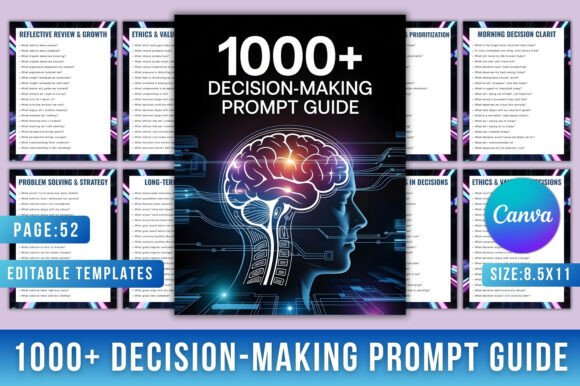
This guide isn’t a journal you fill out once and forget. It’s a reusable resource with 52 Canva pages (8.5x11 inches, 300 DPI, no bleed) that you can adapt week after week. You get an editable Canva link plus ready-to-upload PDF files. Whether you print them or use them digitally, the prompts stay fresh because your answers change as your situation evolves.
Where Does This Guide Fit Into Your Daily Life?
Many people keep a notebook for ideas but rarely have a system for making decisions stick. The 1000 Decision-Making Prompt Guide fills that gap by giving you a framework you can reach for at different moments of the day. Morning decision planning is one of the most practical entry points. Instead of starting your day reacting to emails or notifications, you open a prompt that asks, “What one decision will make everything else easier today?” That single question shifts your focus from busywork to meaningful progress.
Entrepreneurs and freelancers often tell me their biggest bottleneck isn’t skill—it’s deciding what to do next. With this guide, you can spend ten minutes in the morning identifying your highest-impact task. Over time, that habit reduces the mental load of constant choice. You stop second-guessing and start executing.
Another natural use is during weekly or monthly reviews. Reflection and growth prompts encourage you to look back at decisions you made, assess what worked, and adjust your approach. This turns every week into a learning cycle. Instead of repeating mistakes, you document patterns and refine your judgment.
Why the “How” Matters More Than the “What”
A common mistake people make when trying to improve decision-making is focusing only on the outcome. Did I pick the right option? Did it work? But the 1000 Decision-Making Prompt Guide emphasizes the process behind the choice. You’ll find prompts about risk priority assessment, problem-solving frameworks, and goal long-term planning. These aren’t abstract categories—they’re practical lenses you apply to real situations.
Let’s say you’re a small business owner considering whether to launch a new product line. A typical approach might be to list pros and cons, which often leads to bias. With this guide, you might use a risk priority prompt that asks, “What is the worst-case scenario, and how likely is it really?” That reframes the question. You move from vague fear to specific analysis. Then a problem-solving prompt helps you break the launch into smaller steps: what do I need to validate first, and who needs to be involved?
The result is that you make decisions with clearer eyes. You’re not just choosing—you’re building a rationale you can revisit later.
Realistic Use Cases Across Different Roles
One of the strengths of the 1000 Decision-Making Prompt Guide is that it works across contexts. Here are several scenarios where different users find value.
Creators and Bloggers
If you create content, you face constant decisions: what topic to cover, which platform to prioritize, how to structure your week. The prompts help you move past the “should I post this?” hesitation. For instance, a morning prompt might ask, “What does my audience need most right now?” That shifts the focus from your own doubts to serving your readers. Over a few weeks, you develop a content calendar that reflects actual priorities rather than random inspiration.
Many creators also struggle with long-term planning versus daily execution. The guide includes prompts specifically for balancing those two. You might spend Sunday evening reviewing where you want to be in three months, then use weekday prompts to keep those goals alive without feeling overwhelmed.
Entrepreneurs and Freelancers
Running a business means making decisions with incomplete information. You can’t wait for perfect clarity. The 1000 Decision-Making Prompt Guide trains you to act with the information you have. A prompt like “What is the smallest test I can run to learn more?” pushes you toward experimentation instead of analysis paralysis.
Freelancers often face the challenge of pricing their work or choosing clients. The guide includes prompts around value assessment and opportunity cost. You can work through them before a negotiation or when reviewing a contract. Over time, you develop a more grounded sense of what your time is worth.
Educators and Marketers
Teachers and trainers can use the prompts to design lesson plans or workshop structures. Instead of starting from scratch, you use the problem-solving frameworks to identify what students actually need. Marketers use it to choose campaign strategies. A prompt like “Which channel aligns best with my current audience behavior?” turns a guess into a reasoned choice.
The flexibility of the 52-page format means you can assign specific prompts to different projects. You might keep a digital copy for client work and a printed version for personal planning.
Hobbyists and Everyday Users
You don’t need to run a business to benefit. If you’re planning a home renovation, deciding where to travel, or even figuring out how to spend your free time, the prompts give you structure. A hobbyist photographer might use the goal long-term planning prompts to build a portfolio over six months. Someone managing a household can use the risk priority prompts to decide between competing expenses.
The guide works because it doesn’t assume you’re a CEO or a productivity expert. It assumes you have choices to make and want to make them well.
What to Consider Before You Start Using the Guide
While the 1000 Decision-Making Prompt Guide is versatile, a few things will help you get the most out of it. First, consistency matters more than volume. You don’t need to answer dozens of prompts in one sitting. That can feel like homework. Instead, pick one or two prompts per day or per session. The real value comes from returning to them over time and noticing how your thinking evolves.
Second, be honest with yourself. The prompts are designed to surface what you actually think, not what you wish you thought. If a question makes you uncomfortable, that’s usually a sign you’re touching something important. Lean into it rather than skipping it. The guide works best when you treat it as a thinking tool, not a checklist to complete.
Third, choose your format intentionally. The editable Canva link is great if you want to type answers, adjust layouts, or keep everything on your device. The PDF files work well for printing if you prefer writing by hand. Some people use both—print the weekly review pages and keep the daily prompts digital. There’s no wrong way as long as it fits your routine.
Fourth, don’t expect immediate transformation. Decision-making is a skill, and skills improve with practice. The 52-page structure gives you a year of weekly prompts if you pace yourself. You’ll notice shifts after a few weeks, but the bigger changes come after consistent use over months.
How the Features Map to Real Outcomes
Let’s connect a few specific features to the benefits you actually experience. The morning decision planning prompts aren’t just about what you do in the morning. They reduce the friction of starting your day. Instead of waking up to a pile of possibilities, you have one clear focus. That lowers stress and increases follow-through.
The risk priority assessment prompts help you stop worrying about everything equally. Most people either avoid risks or ignore them entirely. These prompts help you sort risks by impact and likelihood. You end up spending energy only where it matters.
The problem-solving frameworks turn vague issues into actionable steps. When you feel stuck, a prompt like “What part of this problem do I actually control?” reorients your mind toward agency rather than frustration.
The goal long-term planning prompts prevent you from drifting. It’s easy to get caught up in urgent tasks and lose sight of where you’re going. Weekly or monthly use of these prompts keeps your long-term vision alive without making it feel abstract.
Finally, the reflection and growth reviews are where you solidify learning. Every decision you made—good or bad—becomes data for your future self. Over time, you develop a personalized decision-making framework based on your own experience, not generic advice.
Why This Guide Stands Out for Long-Term Use
There are many planners and journals on the market, but most either focus on daily tasks or vague goal-setting. The 1000 Decision-Making Prompt Guide sits in a sweet spot. It’s tactical enough for daily decisions and strategic enough for life-shaping choices. The 52-page format gives you room to grow without becoming overwhelming.
Because the prompts are reusable, you can work through the guide multiple times in a year and get different insights each time. Your answers change as your circumstances change. That makes it a long-term tool rather than a one-time exercise.
The combination of the editable Canva link and high-quality PDF files also means you’re not locked into one method. If you prefer digital planning, you can keep everything in Canva or import the PDFs into a note-taking app. If you print them, the 300 DPI resolution ensures clean, readable text.
For anyone who makes decisions regularly—which is everyone—having a structured way to think through choices is an advantage. The 1000 Decision-Making Prompt Guide gives you that structure without making you feel like you’re going through a formula. It’s a practical companion for anyone who wants to think clearly, prioritize better, and act with confidence.