2026 Declutter Journal Workbook – Clear Your Space, Reset Your Mind
If the idea of a calmer, more organized home has felt out of reach, you are not alone. Many people carry the weight of physical clutter alongside mental noise, unsure where to start or how to make lasting change. The 2026 Declutter Journal Workbook offers a structured path forward. It is a 120-page guided planner designed to help you declutter your home, release mental clutter, and build simple organizing habits that last all year. Whether you are preparing for a fresh start, embracing minimal living, or simply trying to feel less overwhelmed, this workbook provides a framework that adapts to your pace and priorities.
What the 2026 Declutter Journal Workbook Actually Does
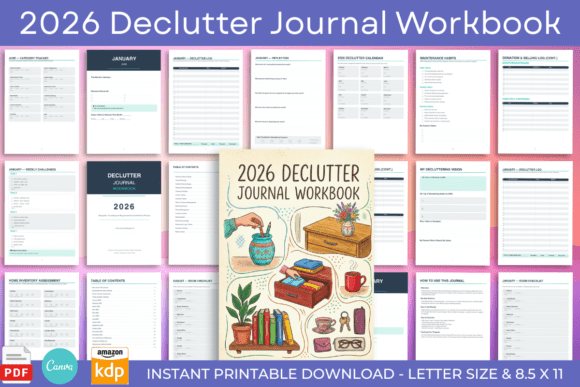
At its core, this workbook transforms an abstract goal—getting organized—into a series of concrete, manageable actions. It begins with a cover page where you set your intention for a clutter-free year. From there, guided prompts help you clarify your motivation and personal reasons for decluttering. This is not about following a rigid system; it is about understanding what matters to you and building momentum from that foundation.
The workbook includes mindset reset pages to shift from overwhelm to clarity, a whole-home declutter overview that breaks your space into manageable zones, and room-by-room plans for the kitchen, bedroom, closet, bathroom, office, and beyond. Decision-making becomes easier with a dedicated Keep • Donate • Trash tracker, so every item you touch has a clear destination. Weekly schedules and daily checklists prevent burnout by encouraging realistic, consistent sessions. There is also a donation disposal log to track items leaving your home and a clutter recurrence log to help you notice patterns over time.
This is not a one-size-fits-all checklist. It is a flexible tool that respects your lifestyle, your living situation, and your personal definition of order.
Why Different People Care About This Workbook
The value of the 2026 Declutter Journal Workbook shifts depending on who you are and what you are trying to accomplish. Here is how different audiences might approach it.
Beginners Who Feel Overwhelmed
If you have never systematically decluttered before, the hardest part is often deciding where to begin. The workbook addresses this directly by asking you to clarify why you want to declutter in the first place. That may sound simple, but naming your reasons—whether it is reducing stress, creating space for a hobby, or preparing for a move—anchors the entire process. The room-by-room plans and weekly schedule prevent you from taking on too much at once. Instead of trying to clean out an entire house in a weekend, you focus on one drawer, one shelf, or one corner at a time. For a beginner, the biggest benefit is not speed. It is developing a reliable process that reduces the chance of burnout or relapse.
Experienced Organizers Looking for a Refresh
People who have decluttered before may still struggle with maintenance. The clutter recurrence log and mindset reset pages become especially useful here. Instead of starting from scratch, you can identify which areas tend to collect clutter again and adjust your habits accordingly. The workbook also provides a structured way to reassess your space annually without reinventing your system. For someone who already knows the basics, the value lies in accountability and pattern recognition, not instruction.
Creatives, Freelancers, and Entrepreneurs
If you work from home or run a small business, your environment directly affects your productivity. A cluttered office or studio creates visual noise that competes for your attention. The workbook helps you treat your workspace with the same care as your living areas. The whole-home overview and room-by-room plans are particularly helpful for creatives who may have multiple zones—materials, inventory, digital files, and samples—that need separate organization strategies. The daily checklists can be adapted to five-minute sessions between client calls, making the process fit a busy schedule rather than requiring large time blocks you do not have.
Educators and Workshop Facilitators
Teachers, coaches, and facilitators who run classes on organization, minimalism, or life skills can use the workbook as a supplemental resource. The clear structure and printable format (based on the PDF page titles) make it easy to assign specific sections as homework or use the mindset prompts as discussion starters. For example, the "Why I Want to Declutter" page can become a reflective writing exercise in a workshop, and the donation disposal log helps participants track their real-world progress between sessions. The workbook serves as a curriculum scaffold that respects individual differences in pace and motivation.
Busy Professionals and Parents
For people juggling careers, family responsibilities, and limited personal time, the appeal of this workbook is its realism. It does not ask you to become a minimalist overnight. It asks you to schedule one small decluttering session each week and track what you accomplish. The weekly schedule and daily checklists are designed for people who cannot afford to spend hours organizing. A parent might use the kitchen plan to clear counter space during nap time. A professional might tackle one closet shelf each Sunday evening. The workbook normalizes incremental progress, which is often the only kind that fits a full life.
Evaluating the Workbook for Your Own Needs
Before you commit to any organizational tool, it helps to think about what matters most to you. Here are some dimensions to consider when deciding whether the 2026 Declutter Journal Workbook matches your goals and lifestyle.
Ease of Use
The workbook is structured as a guided journal, so you do not need prior experience with organizing systems. Each section builds on the previous one, and prompts are written in plain language. If you prefer open-ended exploration over rigid checklists, the mindset pages and goal-setting exercises give you room to adapt. If you want clear direction, the room-by-room plans and trackers provide exactly that.
Cost and Quality
Compared to hiring a professional organizer or buying multiple single-purpose planners, a single workbook that covers mindset, room-by-room plans, schedules, logs, and trackers offers good value. The 120-page format suggests enough depth to carry you through a full year without feeling skimpy. For someone on a budget, this is a self-guided alternative that still offers structure and accountability.
Flexibility
Not every room or tracker will apply to everyone. A person living in a studio apartment may skip the guest room section, while someone with a large home may photocopy extra room-by-room pages. The workbook allows for that kind of customization. You can focus only on the sections that are relevant now and come back to others later. This flexibility makes it suitable for renters, homeowners, and anyone in between.
Long-Term Usefulness
The recurrence log and mindset reset pages are designed for ongoing maintenance, not just a one-time purge. If your goal is to build habits that last, those sections add lasting value. The workbook also serves as a record of your progress—you can look back and see how your relationship with your space changed over time. That reflective quality is something a one-off checklist cannot provide.
Practical Examples for Different Readers
For a remote freelancer: Start with the mindset reset page to clarify why you want a clearer workspace. Then use the office room-by-room plan to sort cables, files, and supplies. Set a weekly schedule of two 15-minute sessions. Use the donation log to track items you remove, and note in the clutter recurrence log which areas need attention again in three months.
For a parent managing a busy household: Begin with the whole-home overview to identify which room causes the most daily stress—likely the kitchen or living room. Use the room-by-room plan for that space first. Keep the daily checklists on the counter and tick off one small task per day, such as clearing the junk drawer or sorting a single shelf. The donation log helps you track what leaves the house, which is motivating when progress feels slow.
For a creative entrepreneur with inventory: Use the workbook to separate personal spaces from business spaces. The keep-donate-trash tracker helps you make clear decisions about materials you no longer use. The weekly schedule prevents you from spending an entire day on organizing when you could be creating or serving clients. Treat the recurrence log as a business tool—notice which supplies pile up fastest and adjust your purchasing habits.
For someone supporting a loved one through a move: The workbook can serve as a gentle guide. Use the "Why I Want to Declutter" page as a conversation starter rather than a solo exercise. Focus on one room at a time, and use the donation log to coordinate drop-offs and pickups. The mindset prompts help both of you stay grounded when emotions run high.
Is This Workbook Right for You?
The 2026 Declutter Journal Workbook suits anyone who wants a structured but flexible approach to organizing their space and mind. It is not a quick fix. It is a year-long companion that respects your schedule, your reasons, and your pace. If you are looking for a system that combines practical tracking with reflective prompts, and you want something that works across different rooms and life situations, this workbook is worth a closer look. On the other hand, if you prefer a purely digital system or a very rigid set of rules, you may want to adapt the pages to your own workflow. The workbook provides a solid framework, but your willingness to engage with it regularly will determine the results.
Ultimately, decluttering is not just about removing things. It is about making space for what matters. A clear home and a calm mind do not happen by accident. They happen when you have a plan that fits your life—and the courage to begin.