Building Early Literacy with Alphabet Tracing Activity Pages for Kids
Why Alphabet Tracing Matters in Early Childhood Development
The journey toward literacy begins long before a child reads their first word. It starts with recognizing shapes, understanding that symbols carry meaning, and developing the fine motor control needed to reproduce those symbols. Alphabet Tracing Activity Pages for Kids serve as a bridge between scribbling and purposeful writing, giving young learners a structured yet playful way to engage with each letter of the alphabet. When a child traces the curve of a C or the straight lines of an E, they are not merely copying shapes—they are building neural pathways that connect visual recognition with physical action. This dual engagement strengthens letter memory and lays a foundation for fluent handwriting later on.
Educators and developmental specialists have long observed that tracing activities help children internalize letter formation rules without the frustration of freehand drawing. The guided motion reduces cognitive load, allowing the child to focus on the letter's distinctive features rather than worrying about where to start or stop. Over time, this repeated practice transitions into automaticity, meaning the child can write letters without consciously thinking about each stroke. For preschoolers and early learners who are just beginning to explore the written world, Alphabet Tracing Activity Pages for Kids offer exactly the right amount of support and challenge.
A Closer Look at the Interior Design and Practical Features
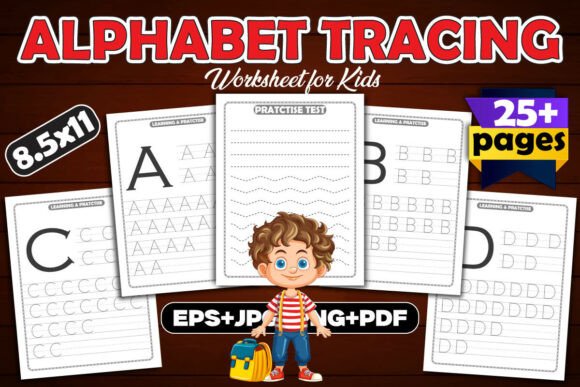
The set described here includes 25 tracing pages, each dedicated to a specific letter of the alphabet. That means every sheet focuses on one letter, giving the child ample opportunity to practice both uppercase and lowercase forms. The decision to keep the pages black and white is deliberate; it minimizes distractions and lets the letter shapes command attention. Young children are naturally drawn to colors, but when the goal is handwriting practice, a clean, high-contrast layout is far more effective.
Technical Specifications That Matter for Print and Digital Use
- Page dimensions: 8.5x11 inches, a standard size that fits easily into binders, folders, or clipboards.
- Resolution: 300 DPI, ensuring crisp lines and smooth curves whether printed at home or at a professional shop.
- File formats provided: EPS, PDF, JPG, and PNG. This variety means educators, parents, and content creators can open the files in nearly any software—Adobe Illustrator, Microsoft Word, Canva, or even basic image viewers.
- Print readiness: Each format is optimized for printing with no additional adjustments required. Simply download, open, and print as many copies as needed.
Having multiple file formats is not just a convenience; it is a practical necessity for different workflows. A classroom teacher might print the PDF directly for a morning center activity, while a homeschooling parent could load the JPG into a tablet for digital tracing using a stylus. A content creator building a teaching resource pack might prefer the EPS for customization. This flexibility makes Alphabet Tracing Activity Pages for Kids suitable for a wide range of users, from the busy educator to the creative entrepreneur assembling their own learning materials.
Who Benefits Most from These Tracing Pages
The audience for alphabet tracing resources is broader than many assume. While preschoolers are the most obvious group, several other users find immense value in these pages.
Preschool and Kindergarten Educators
Teachers in early childhood settings need ready-to-use materials that align with developmental milestones. These tracing pages can be incorporated into daily morning work, literacy stations, or take-home practice packets. Because they are print-ready and require no prep beyond hitting the print button, they save hours of lesson planning. An educator might use them during small group instruction, guiding a handful of children through proper pencil grip and stroke order while the rest of the class works independently.
Homeschooling Parents and Caregivers
Parents who educate their children at home often assemble their own curriculum piece by piece. Having a reliable set of tracing pages means they can introduce letters in any sequence that suits their child's pace. If a child is struggling with the letter B, the parent can print that single page and offer targeted practice without wasting paper on letters already mastered. The black-and-white design also means the child can color the surrounding space after tracing, turning the activity into a two-step learning experience: writing first, then creative expression.
Occupational Therapists and Special Education Specialists
Fine motor delays can hinder a child's progress in handwriting. Therapists often use tracing as a therapeutic intervention because it provides clear boundaries and repeated practice. The high-quality 300 DPI resolution ensures that the lines are precise and consistent, which is critical when assessing a child's motor control. Therapists can also use the EPS files to modify the page—for instance, adding directional arrows or numbered stroke sequences—to tailor the activity to an individual child's needs.
Content Creators and Educational Influencers
Teachers pay creators, curriculum designers, and educational bloggers frequently produce printable resources for their audiences. Having a set of alphabet tracing pages that come in multiple formats (PDF, JPG, PNG, EPS) allows these creators to incorporate the pages into larger bundles, edit them for branding, or repurpose them as digital products. The commercial versatility of these files cannot be overstated; a single purchase can serve as a foundation for multiple products.
Practical Use Cases Across Different Learning Environments
The real value of any educational resource lies in how it adapts to real-world contexts. Alphabet Tracing Activity Pages for Kids are not one-size-fits-all, but rather a versatile tool that can be deployed in several effective ways.
Daily Warm-Up Activity
In a classroom setting, the first ten minutes of the day can set the tone for learning. Placing a tracing page at each desk gives children a focused, low-stakes task to complete as they arrive. This routine builds consistency and signals that learning has begun. Over the course of a school year, cycling through all 25 pages multiple times reinforces letter knowledge and improves handwriting speed.
Travel and Waiting-Time Occupier
Parents know the struggle of keeping a young child occupied during a restaurant meal, a doctor's appointment, or a long car ride. A laminated tracing page paired with a dry-erase marker becomes a reusable, mess-free activity. The child practices letters while the parent enjoys a few minutes of calm. Because the pages are black and white, they also work well with colored pencils or crayons for a more traditional coloring experience.
Digital Tracing on Tablets
With the growing prevalence of tablets in homes and classrooms, digital tracing has become a popular alternative to paper. The JPG and PNG files can be imported into drawing apps like Procreate, Notability, or GoodNotes, allowing children to trace with a stylus. This approach appeals to tech-savvy learners and reduces paper waste. Teachers who use classroom management apps can distribute the pages digitally as well, making them accessible to students who are learning remotely.
Supplementary Material for Letter-of-the-Week Programs
Many early childhood curricula follow a letter-of-the-week format. When the focus is on the letter M, for example, the tracing page for M becomes the centerpiece of handwriting practice. Teachers can pair it with songs, stories, and crafts that all reinforce the same letter. The consistency of seeing the letter in written form multiple times across different activities helps solidify recognition.
Observations on Learning Outcomes and Confidence Building
One of the most striking effects of regular tracing practice is the boost in a child's confidence. When a child completes a page and sees a full row of well-formed letters, they experience a tangible sense of accomplishment. This success is critical for young learners who may otherwise feel intimidated by the complexity of writing. The page provides a safe space—the child cannot fail because the guide is right there, and each attempt brings them closer to mastery.
Additionally, tracing supports letter recognition in a multisensory way. The child sees the letter, says its name (often aloud with a parent or teacher), and physically moves their hand to create it. This combination of visual, auditory, and kinesthetic input is far more powerful than any single modality alone. Research in early literacy consistently shows that multisensory approaches yield stronger retention, especially for children who are at risk for reading difficulties.
Caregivers often notice that children who practice tracing regularly develop better pencil grip and posture over time. The repeated motion of following a line trains the small muscles of the hand and fingers, which eventually translates into more legible handwriting and less fatigue during longer writing tasks. These motor skills are not just about letters—they also support drawing, cutting with scissors, tying shoelaces, and other fine-motor activities.
Considerations for Choosing and Using Alphabet Tracing Pages
Not all tracing resources are created equal, and there are a few factors worth considering when selecting pages for a child or classroom.
Line Quality and Clarity
The 300 DPI specification in this set ensures that lines are sharp and consistent. Low-resolution tracing pages often have jagged or blurry lines, which can confuse a child who is trying to follow a precise path. High clarity matters especially for younger children who are still developing visual discrimination skills.
Format Flexibility
As noted, having EPS, PDF, JPG, and PNG files opens up many possibilities. Users who only need to print repeatedly might find PDF sufficient, but those who want to resize, edit, or combine pages into larger workbooks will appreciate the vector EPS format. Before purchasing any tracing resource, it is wise to check which formats are included to ensure compatibility with your intended workflow.
Age Appropriateness
Tracing pages are most effective for children aged 3 to 6, though older children with fine motor delays may also benefit. For toddlers just beginning to hold a crayon, larger letter outlines with dotted lines are ideal. For kindergartners who are ready for thinner lines and smaller letter sizes, these standard pages work well. The key is to match the difficulty level to the child's current stage without pushing too fast.
Reusability
Laminating the pages or placing them in sheet protectors allows them to be used repeatedly with dry-erase markers. This is a cost-effective strategy for classrooms and families alike. One laminated set can last an entire school year, with children practicing each letter multiple times until mastery is achieved.
Integrating Tracing Pages into a Broader Literacy Routine
Tracing alone is not enough to build complete literacy, but it plays a supporting role that complements other activities. A balanced early literacy routine might include:
- Phonemic awareness games where children identify the sounds that each letter makes.
- Read-aloud sessions that expose children to letters in context within stories.
- Letter hunt activities where children find specific letters in books, signs, or labels around the room.
- Tracing practice using the activity pages to reinforce letter formation and recognition.
- Free writing and drawing where children apply their skills in creative ways, even if the letters are not perfectly formed.
When tracing is part of this larger ecosystem, it becomes a stepping stone rather than a standalone task. Children see the purpose behind the practice: they are learning to write so they can write their name, label a drawing, or eventually compose sentences. The Alphabet Tracing Activity Pages for Kids fit naturally into this framework, providing the repetition and structure that young learners need without stifling their creativity.
Final Thoughts on the Value of a Simple Tool
There is a reason alphabet tracing pages have remained a staple in early education for generations. They are simple, effective, and adaptable. The pages described here—25 letter-focused sheets in multiple print-ready formats with 300 DPI quality—represent a well-designed version of this classic tool. Whether used in a classroom, a homeschool room, a therapy clinic, or a digital learning app, they support the essential work of helping children master the building blocks of written language. For educators, parents, and creators looking for a reliable, flexible resource, these pages offer a practical and lasting solution.