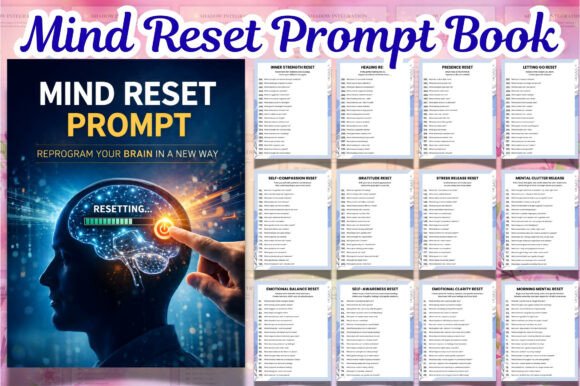
Mind Reset Prompt Book: A Gentle Path to Mental Clarity and Inner Calm
Life gets loud. Between notifications, deadlines, and the quiet hum of daily responsibilities, it’s easy to lose touch with the stillness inside. You might find yourself staring at a to-do list that never ends, feeling mentally foggy, or simply craving a pause. That’s where the Mind Reset Prompt Book steps in—a thoughtfully designed printable journal that helps you release mental clutter and reconnect with your own calm. It’s not about radical overhauls or rigid self-improvement. It’s about giving yourself permission to slow down, even for just a few minutes, and letting your thoughts settle.
What Exactly Is This Prompt Book?
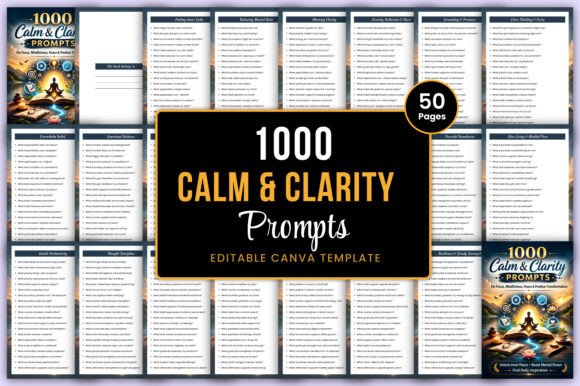
Put simply, the Mind Reset Prompt Book is a collection of 300 guided prompts organized into sections like morning mindset resets, emotional clarity, stress relief, gratitude, self-compassion, focus, and personal renewal. Each prompt acts as a gentle nudge—a question, an observation, a small invitation to notice what’s happening in your head and heart. Unlike open-ended journaling that can feel overwhelming when you’re already scattered, these prompts provide structure without being rigid. You can use one page a day, or flip to a specific section when you need a mental reset in the middle of a hectic afternoon.
The format is simple: PDF, JPG, PNG, and even a Canva link so you can edit or tweak it to feel truly yours. It’s print-ready and instantly downloadable, which means you can start using it within minutes of deciding to give yourself that break.
When the Morning Feels Like a Sprint
Imagine waking up already behind—your mind racing with everything that needs to happen before breakfast. Instead of reaching for your phone, you open the Mind Reset Prompt Book to a morning mindset reflection. One prompt might ask: “What is one thing I can let go of today?” That simple question shifts your focus from pressure to permission. You jot down a quick thought, and suddenly the day feels more manageable. It’s a tiny ritual that reminds you that you get to choose your pace.
Midday Overwhelm and the Need to Unclutter
You’re at your desk, maybe three hours deep into back-to-back tasks, and your brain feels like a browser with thirty tabs open. The mental clutter release exercises in the book are designed for these moments. A prompt like “List three thoughts that are taking up space right now” helps you externalize what’s swirling. By writing them down, you create distance. It’s not about solving problems instantly—it’s about giving your mind room to breathe.
Emotional Waves That Need a Gentle Channel
Maybe you’ve just had a difficult conversation, or you’re sitting with feelings you can’t name. The emotional clarity and awareness sections offer prompts that don’t demand you “fix” anything. They simply ask: “What am I feeling right now, without judgment?” That phrasing matters—it lowers the pressure to be okay. For someone navigating grief, anxiety, or just a rough day, this kind of prompt becomes a safe landing place.
Evening Wind-Down and Self-Compassion
After a long day, it’s easy to replay mistakes or worry about tomorrow. The self-compassion and gratitude prompts help you close the loop with kindness. One might ask: “What did I do today that deserves recognition?” It’s not about toxic positivity—it’s about acknowledging effort, however small. Pair that with a focus prompt like “What was one moment I was fully present?”, and you start training your brain to notice the good, not just the stress.
Different Users, Different Needs
One of the strengths of the Mind Reset Prompt Book is how it adapts to different lifestyles and personalities.
- Busy professionals who feel burned out can use the stress relief and relaxation reflections as a quick lunch-break reset. Instead of scrolling social media, a five-minute journaling pause can lower cortisol and improve focus for the afternoon.
- Parents and caregivers often operate in survival mode, putting everyone else first. The personal renewal themes offer a quiet space to check in with themselves. A prompt like “What nurtured me today?” helps them reconnect with their own needs.
- Creatives and freelancers might struggle with mental blocks or self-doubt. The focus and mindfulness prompts can break perfectionism loops. For example, “Describe a small step I can take without expecting it to be perfect.” That kind of guidance loosens the grip of “should.”
- Students and young adults facing academic pressure or identity questions can benefit from the emotional clarity exercises. It’s a private, no-stakes way to untangle thoughts without having to talk to someone else right away.
- Anyone on a personal growth journey might use the healing and renewal themes to track emotional patterns over time. The structure allows you to revisit old entries and notice how your perspective shifts.
Practical Examples of Using the Prompts
Let’s say you’re feeling irritable and can’t pinpoint why. You flip to the emotional clarity section and find: “Without thinking too hard, complete this sentence: I feel irritated because….” You write, “I feel irritated because I haven’t had a moment to myself all day.” Suddenly it’s not about the irritation anymore—it’s about a need for solitude. That awareness alone can shift how you respond to the next trigger.
Or maybe you’re struggling with focus. A prompt like “What is one physical sensation I’m ignoring right now?” brings your attention back to your body. You realize you’re hungry, tense, or tired. Addressing that basic need can restore your ability to concentrate better than any productivity hack.
Another example: the stress release section might include “Write down one worry, then crumple the paper or scroll away before reading it again.” It’s a small symbolic act that interrupts rumination. You’re not dismissing the worry; you’re giving your brain a break from circling it.
Before You Start: What to Consider
The Mind Reset Prompt Book is designed for ease, but it helps to set realistic expectations. Here are a few observations from using similar tools:
- Consistency is more valuable than length. You don’t need to fill an entire page. Some days you’ll write a sentence; others, a paragraph. The goal is showing up, not producing a polished entry.
- Choose your format wisely. If you prefer handwriting, print the PDF. If you’re often away from home, the JPG or PNG files work on tablets. The Canva link lets you customize—maybe you want to add a quote or change colors to match your mood.
- Don’t force prompts. If one doesn’t resonate, skip it. The book has 300 options; you’re allowed to be picky. The prompts are invitations, not assignments.
- Its limitations are part of its honesty. This is a reflective tool, not a substitute for therapy or medical advice. If you’re dealing with severe depression, trauma, or persistent anxiety, professional support is essential. The prompt book works best as a complement—a gentle practice between sessions or on good days when you need to ground yourself.
Strengths That Stand Out
What makes this resource particularly effective is its variety. Many journals focus on one aspect—gratitude or mindfulness only—but the Mind Reset Prompt Book weaves together multiple themes. You can move from emotional awareness to stress release to gratitude in the same sitting, which mirrors the natural flow of thoughts. The “reset” part is genuine: you’re not building a habit of positivity at all costs; you’re clearing space for whatever is present.
Another strength is the gentle language. The prompts avoid jargon like “manifest” or “optimize.” Instead, they use words like “observe,” “notice,” “pause.” That makes it accessible for journaling beginners and refreshing for experienced practitioners who want a less commercial approach.
The printable nature is also a plus. You can bind it, keep it in a folder, or use single pages. No shipping, no waste of paper you don’t use. And because it’s digital, you can print duplicates for different seasons of your life.
Potential Limitations to Keep in Mind
No tool is perfect for everyone. Some users might find 300 prompts intimidating—where to start? A quick suggestion: open to a random page, or pick the section that matches how you’re feeling right now. Another limitation: if you strongly prefer guided video meditations or audio prompts, a text-based journal might feel quiet. But for many, that silence is precisely the point—it lets your own voice rise.
Also, because it’s self-directed, you need a bit of intrinsic motivation. The book won’t tap you on the shoulder. But if you carve out even five minutes and set a small intention, the prompts do the rest.
Who Might Find This Especially Helpful?
Think about the person who has tried bullet journaling but found it too demanding. Or the one who buys mindfulness books but never finishes them. The Mind Reset Prompt Book fits a gap: structured enough to reduce decision fatigue, flexible enough to honor real life. It’s also great for someone who wants to start a journaling habit without the blank-page anxiety.
Corporate wellness initiatives might consider printing copies for teams. Counselors or coaches could use selected prompts as take-home exercises. And for individuals, it’s a companion for quiet mornings, travel, or evenings when you just need to put the world down for a bit.
The Mind Reset Prompt Book doesn’t promise to fix your life. It promises to help you reset—again and again, as many times as you need. And in a world that constantly demands more, having a tool that invites you to pause, notice, and release is a quiet kind of revolution.