A Little Kid's Feelings Book: A Gentle Guide
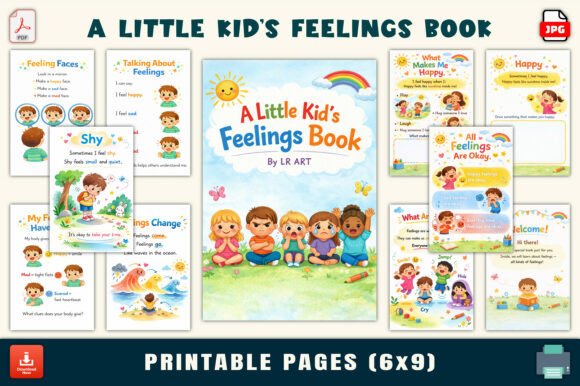
Emotions can feel enormous to a young child. One moment a child might be laughing with joy, and the next they might be tangled in frustration or sadness they cannot name. A Little Kid's Feelings Book steps into this tender space as a 34-page emotional learning eBook designed for children ages 4 to 8. Instead of lecturing or overwhelming young readers, this resource meets them exactly where they are. Each page uses short, simple sentences that a child can understand and connect with, while exploring feelings like happy, sad, mad, scared, excited, calm, loving, shy, jealous, proud, silly, and even the confusing weight of big feelings. The book also includes interactive reflection pages such as “Draw your feeling,” “Make feeling faces,” “Today I feel…” journaling prompts, a “My Feelings Toolbox” page, breathing and calming exercises, and gentle lessons on asking for help and showing kindness. Available in both JPG and PDF formats at 6 × 9 inches, this eBook can be used digitally or printed at home or school.
The real power of this book lies not just in what it teaches, but in how it invites children to participate. It does not simply tell a child what anger or jealousy means; it asks them to draw their emotion, to look in a mirror and make a face, or to pause and breathe. For adults who care for or work with young children, this structure makes emotional literacy feel less like a lesson and more like a shared activity. Whether you are a parent reading at the kitchen table, a counselor guiding a small group, or a teacher weaving emotional awareness into a morning meeting, this resource adapts to your setting without losing its gentle, child-first tone.
Why Different Readers Care About Emotional Learning for Kids
Adults come to a resource like this from very different starting points. A parent might want a way to help their child through a difficult transition, such as a new sibling or a move to a new school. A therapist may need a structured yet flexible tool for sessions with young clients. A homeschooling parent might be looking for a way to integrate social-emotional learning into their daily routine without a rigid curriculum. Each person evaluates the book based on their own priorities: ease of use, cost, quality, flexibility, or long-term usefulness. Recognizing these different perspectives can help you decide whether this book fits your specific situation.
For Parents and Caregivers: Building Bridges at Home
If you are a parent or primary caregiver, you already know that children do not always have the words to tell you what they are feeling. A meltdown over a broken crayon might actually be about exhaustion, hunger, or a hard day at preschool. A Little Kid's Feelings Book gives you a shared language to explore those moments together. The “Today I feel…” journaling prompt, for example, can become part of your bedtime routine. You and your child can look at the emotion pages, point to how they are feeling, and then draw or talk about it.
One practical example: your child comes home from school unusually quiet. Instead of asking “What’s wrong?” — a question that can feel too big — you might open the book to the Scared or Sad page. You read the short sentence together, and then you invite your child to draw their feeling in the space provided. This small shift changes the dynamic. The book becomes a neutral, safe third party. For beginners who are new to emotional learning resources, this book is especially welcoming because it requires no special training. You do not need to be a therapist or a teacher. You just need to be present. The cost is low, the format is simple, and the pages are designed to be used again and again, especially if you print them or use them digitally with a stylus or drawing app.
For Educators and Teachers: A Flexible Classroom Tool
Teachers in early elementary classrooms often face the challenge of managing a range of emotions among twenty or more children, all while trying to deliver academic content. Social-emotional learning is not an add-on; it is the foundation that makes everything else possible. A Little Kid's Feelings Book can serve as a calm-down corner resource, a morning check-in activity, or a whole-class lesson on a specific emotion like jealousy or pride.
Imagine it is Monday morning and several students seem irritable or distracted. You might project the “Big Feelings” page on a screen or pass out printed copies. You ask each child to circle how they are feeling and then draw one thing that happened over the weekend. This takes five minutes, but it gives you invaluable insight into your students’ emotional states. For experienced educators who have used other SEL programs, this book may feel less like a curriculum and more like a supplemental tool. It does not prescribe a sequence of lessons or require training. Instead, it offers quality, printable pages that fit into whatever structure you already have. The page size (6 × 9 inches) is compact enough for individual use but can also be enlarged for group settings. Teachers who value flexibility and speed will appreciate that they can print a single page for a specific need — like the breathing exercises or the “My Feelings Toolbox” — without using the entire book.
For Counselors and Therapists: A Gentle Clinical Companion
Mental health professionals who work with children ages 4 to 8 often need resources that are both engaging and clinically sound. While this eBook is not a therapy manual, it can be a valuable part of a therapeutic toolbox. The interactive pages — such as “Make feeling faces” and “Draw your feeling” — align with common expressive therapy techniques. A counselor might use the Scared page to start a conversation about what fear looks like in the body, or the Calm page to practice grounding exercises.
For a therapist seeing a shy child who struggles to identify emotions, the simple format can reduce anxiety. The child does not feel tested. They are just looking at a friendly page with a word and a space to draw. Over several sessions, the “Today I feel…” prompt can become a ritual that tracks emotional patterns. Reliability matters in clinical settings, and this book’s consistent structure across all 34 pages helps children feel safe and predictable. Professionals may also appreciate that the content is non-religious and broadly inclusive, making it suitable for diverse families. The digital format means you can print fresh copies for each client, or use a tablet in session for a paper-free experience.
For Homeschoolers: Integrating Emotional Learning into Daily Life
Homeschooling parents often look for resources that are both educational and flexible enough to adapt to different ages and learning styles. A Little Kid's Feelings Book fits well into a morning basket or a weekly social-emotional learning block. Because it is not tied to a specific curriculum, you can use it in whatever order makes sense for your family. Perhaps one week your child is struggling with sibling rivalry, so you spend extra time on the Jealous page. Another week, you might focus on Proud after your child accomplishes a difficult task.
The creative value here is high. You can pair the “Draw your feeling” page with art supplies, use the breathing exercises as a transition between subjects, or create a feelings chart on the wall using printed pages. For homeschoolers with multiple children, you can print several copies so each child can work independently. The cost is minimal compared to full SEL curricula, and the 6 × 9 inch size makes it easy to store in a binder or folder. Long-term usefulness is strong because emotions do not go away; the same pages can be revisited at different developmental stages with deeper conversations each time.
For Content Creators and Small Business Owners: Quality and Customization Potential
Creators who run printables shops, educational blogs, or parenting resources may look at A Little Kid's Feelings Book with a different lens. You might evaluate the design quality, the emotional depth of the content, and whether it fills a gap in your own offerings. For a small business owner who sells resources for teachers or parents, this book could be a product you recommend or bundle with other social-emotional tools.
If you are a blogger or content creator writing about emotional intelligence in early childhood, this eBook provides concrete examples you can reference in your articles. You might use the Scared or Happy pages as examples of how to talk to children about feelings. The JPG format also means you could use individual pages in social media posts or email newsletters (with proper attribution, of course). For creators who design their own products, studying the structure of this book — short sentences, interactive elements, a single emotional focus per page — can inspire your own projects. The presentation is clean, child-friendly, and professional without being clinical. If you are considering creating your own emotional learning resource, this book serves as a useful benchmark for quality and simplicity.
What to Consider Before Choosing This Book
No single resource works for every situation. While A Little Kid's Feelings Book is versatile, it helps to think about what you specifically need. If you are looking for a full lesson plan with detailed instructions, this is not that. It is a gentle, open-ended tool that relies on the adult to guide the conversation. If you need a resource that covers more complex emotional topics like trauma or grief in depth, this book introduces emotions at a basic level appropriate for young children, but it does not delve into advanced therapeutic content.
For parents and educators working with children at the younger end of the age range (4 to 5 years), the drawing and face-making activities will likely be the most engaging. Older children (7 to 8 years) may enjoy the journaling prompts and the “My Feelings Toolbox” page, where they can list strategies that help them feel better. The book is flexible enough to grow with the child, but it does not include separate versions for different ages within the same file. You, as the adult, choose how to use each page.
Cost is another factor. As a digital product, this eBook eliminates printing and shipping expenses, and you can use it with multiple children or clients without buying additional copies. However, if you prefer a physical book that a child can hold and turn pages, you would need to print it yourself or bind it. The high-quality printable files are designed to look good whether you print at home or at a professional shop. The 6 × 9 inch size is smaller than a standard letter page, which makes it feel more like a real book in a child’s hands, but you can also print multiple pages on one sheet for a smaller format or activity cards.
Evaluating the Learning Value and Practical Use
The learning value of this book comes less from the information it conveys and more from the conversations it starts. A page that simply says “Sad” and shows a simple face does not teach a child everything about sadness. But when you sit with that page and ask, “When do you feel sad? What does sad look like in your body? What helps you feel better?” — that is where the real learning happens. The book provides the container; you provide the connection.
For adults who are beginners at emotional learning, this low-pressure format is ideal. There is no right or wrong way to use the pages. You do not have to follow a sequence. You can skip around based on what the child needs that day. For experienced educators, counselors, or parents who have used many emotional learning tools, this book may feel familiar in its approach, but the quality of the interactive pages and the inclusion of calming exercises make it a solid addition to your collection rather than a replacement for other resources.
One practical example across audiences: a child is feeling jealous because a friend got a new toy. A parent might open the Jealous page and read the sentence aloud. Then they might say, “Let’s draw what jealousy looks like. Is it a color? A shape?” The child draws a green scribble. The parent validates the feeling without fixing it. Later, they return to the “My Feelings Toolbox” page and add “Tell someone how I feel” or “Take three deep breaths” as a strategy. In a classroom, the same scenario could happen in a small group. In a therapy session, it becomes a springboard for exploring the child’s relationships. The same tool works differently depending on the setting, and that flexibility is one of its strongest qualities.
Making the Decision That Fits Your Needs
If you are still wondering whether A Little Kid's Feelings Book aligns with your goals, ask yourself a few simple questions. Do you want a resource that is ready to use without prep time? Yes, this book delivers that. Do you need something that works both on a screen and on paper? Yes, the JPG and PDF formats cover both. Are you looking for a tool that respects a child’s emotional world without being prescriptive or moralizing? The tone throughout is gentle, validating, and focused on expression rather than behavior modification.
For the adult who is busy, tired, and wants to help a child without adding complexity to their day, this eBook offers a direct path. Print a page or open it on a tablet. Ask a simple question. Let the child lead. That is enough. For the professional who needs reliable, high-quality materials for their work, the clean design and thoughtful structure make this a resource you can confidently reach for again and again. And for the creator or entrepreneur looking to understand what a good emotional learning resource looks like, this book demonstrates how simplicity, interactivity, and emotional honesty combine into something genuinely useful.
Emotional learning does not happen in a single session or with a single book. It happens in small moments repeated over time. A Little Kid's Feelings Book is designed to support those small moments — whether at home, in a classroom, or in a therapy office. If that sounds like the kind of help you are looking for, it may be worth a closer look.