Exercise Tracker Journal: A Practical Tool for Measuring Fitness Progress
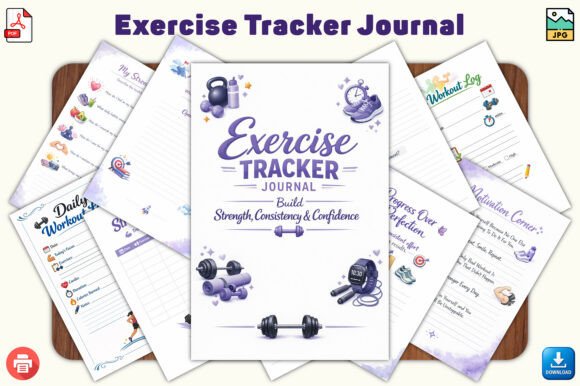
Tracking fitness progress is one of the most effective ways to stay consistent and see measurable results over time. The Exercise Tracker Journal is a structured, 30-page notebook designed to help individuals log workouts, set goals, and reflect on their training habits. With a clean, minimal layout and faint pastel lavender accents, this journal focuses on providing ample writing space and clear organizational sections without unnecessary visual clutter.
This article is written for people who are considering whether a dedicated fitness journal is right for them. Instead of simply describing the product, we examine what the Exercise Tracker Journal offers, where it fits into a fitness routine, and what tradeoffs or limitations you should be aware of before making a purchase.
What the Exercise Tracker Journal Offers
The Exercise Tracker Journal is a print-ready, Canva-editable document that includes goal-setting pages, weekly workout planners, daily workout logs, strength and cardio trackers, habit tracking pages, nutrition and energy reflection sections, recovery and rest logs, monthly progress reviews, a 30-day challenge tracker, and motivation reflection pages. The journal is sized at 6 by 9 inches and includes both high-quality JPG files and a print-ready PDF.
The design philosophy centers on minimalism. Roughly 80 percent of each page is white space, which reduces visual distraction and leaves room for handwritten notes. The faint pastel lavender edges provide a subtle aesthetic touch without overwhelming the functional layout. This combination makes the journal suitable for people who prefer a clean, no-fuss tracking system.
Why Someone Might Be Interested in a Fitness Journal
Many people start a workout routine with enthusiasm but lose momentum after a few weeks. One common reason is a lack of visible progress. When you cannot see how far you have come, it is easy to feel stuck. A tracking journal addresses this by providing a concrete record of what you did, how you felt, and what changed over time.
A structured journal also encourages accountability. Writing down a workout plan at the beginning of the week makes it more likely you will follow through. Recording each session afterward gives you a sense of completion and allows you to spot patterns in your energy levels, recovery, and performance.
For people who train with specific goals in mind such as increasing strength, improving endurance, or building a consistent habit a journal becomes a reference point. You can look back at previous months and see exactly which exercises, weights, or durations led to progress. This is far more reliable than relying on memory alone.
Measurable Progress Over Time
One of the strongest arguments for using the Exercise Tracker Journal is that it turns vague aspirations into measurable data. Instead of thinking "I feel stronger," you can point to a specific page that shows your squat weight increased by ten pounds over six weeks. This kind of concrete evidence is motivating and helps you make informed decisions about your training.
Goal-Focused Reflection Prompts
The journal includes reflection sections that go beyond simple logging. These prompts ask you to consider what worked, what did not, and how you felt physically and mentally. Over time, this builds self-awareness and helps you adjust your approach rather than repeating the same ineffective routines.
Clean Layout Reduces Friction
Because the design emphasizes white space and minimal elements, you are less likely to feel overwhelmed when opening the journal. The pages are straightforward: you see where to write the date, the exercise, the sets and reps, and any notes. There is no need to interpret complicated charts or color codes.
Flexibility for Different Training Styles
The journal includes sections for strength training, cardio, habit tracking, and recovery. This means it can accommodate a wide range of fitness approaches, from weightlifting and running to yoga and bodyweight workouts. The 30-day challenge tracker also adds a short-term goal element for people who enjoy focused, time-bound challenges.
Tradeoffs and Considerations to Keep in Mind
No single tool fits every person perfectly, and the Exercise Tracker Journal has limitations that are worth understanding before you commit to it.
Paper Based Tracking Requires Consistency
Unlike a digital app that syncs automatically, a paper journal requires you to remember to bring it to the gym or keep it accessible at home. If you frequently forget to log your workouts, you may end up with incomplete records. This is not a flaw of the journal itself, but it is a practical consideration for people who prefer digital solutions.
30 Pages May Feel Limited for Long-Term Use
With 30 pages, this journal is best suited for a monthly or short-term tracking cycle. If you plan to track your training for six months or a year, you will need multiple copies. The monthly progress review and 30-day challenge tracker are designed around shorter timeframes, which aligns with a focused, periodic approach rather than a perpetual logbook.
Minimal Design May Not Suit Everyone's Taste
While the clean aesthetic appeals to many, some people prefer journals with more color, graphics, or inspirational quotes. The Exercise Tracker Journal intentionally avoids these elements. If you are someone who thrives on visual stimulation or decorative layouts, this journal might feel too sparse.
Nutrition and Energy Reflection Is Basic
The journal includes pages for nutrition and energy reflection, but these sections are not detailed meal planners or calorie counters. If your primary goal is detailed dietary tracking, you may need a separate nutrition journal or app. The Exercise Tracker Journal treats nutrition as a supporting element of fitness rather than a standalone focus.
Situations Where the Exercise Tracker Journal Is a Strong Fit
This journal works well for several specific scenarios.
- Beginners establishing a routine. If you are new to fitness and want a simple way to build consistency, the structured pages reduce the guesswork. You can follow the layout without needing prior tracking experience.
- Gym goers who want a portable log. The 6 by 9 inch size fits into most bags. You can take it to the gym and write between sets without feeling cumbersome.
- Home workout enthusiasts. Because the journal is not tied to specific gym equipment, it works equally well for bodyweight training, resistance bands, or free weights at home.
- People preparing for a short-term challenge. The 30-day challenge tracker and goal-setting pages make this journal ideal for someone starting a focused program like a strength phase or a running plan.
- Personal trainers who provide printed journals to clients. The Canva-editable format allows trainers to customize pages or add their own branding before printing.
Situations Where Alternatives May Be Worth Considering
There are also scenarios where a different tracking method might serve you better.
- If you prefer digital tracking with automatic analysis. Apps like Strong, Hevy, or FitNotes automatically calculate volume, progression, and rest times. They also store unlimited history. If you value data analysis and convenience over handwriting, a digital app is likely a better fit.
- If you need detailed nutrition or macro tracking. While the Exercise Tracker Journal includes a nutrition reflection page, it is not a comprehensive food diary. For people who want to log every meal and calculate macros, a dedicated nutrition app or a more detailed food journal would be more appropriate.
- If you want a long-term, undated journal. Because this journal has 30 pages intended for monthly use, you would need multiple copies for extended tracking. Some undated journals offer 100 or more pages and can last several months in a single notebook.
- If you prefer guided workout programming. The Exercise Tracker Journal is a blank template for your own workouts. It does not include pre-written exercise programs or coaching advice. If you want a journal that tells you what to do each day, look for a program-specific training log.
Practical Decision-Making Insights
When deciding whether the Exercise Tracker Journal aligns with your needs, start by asking yourself a few questions.
First, consider how you currently track your workouts. If you already use a digital app and are satisfied with it, switching to paper may feel like a step backward. However, if you find that apps distract you with notifications or tempt you to scroll rather than train, a paper journal can offer a more focused experience.
Second, think about how long you typically stick with a tracking habit. If you tend to try a new method every few weeks, a 30-page journal is a low-risk investment. If you are the type of person who wants to commit to a system for a full year, you may want to calculate the cost of purchasing multiple copies and compare that to a single, larger journal.
Third, evaluate how much detail you want to capture. The Exercise Tracker Journal provides fields for sets, reps, weight, duration, and notes. If you need space for things like heart rate, RPE, or specific technique notes, you may want to check whether the page layout accommodates that. For many users, the provided fields are sufficient, but advanced lifters sometimes prefer more granular logging options.
Fourth, consider your environment. If you train at a busy gym where you cannot easily sit down and write, a paper journal may feel impractical. In that case, you might log workouts immediately after training or use a phone app instead. If you train at home or in a quieter setting, writing in a journal feels more natural.
Final Thoughts on the Exercise Tracker Journal
The Exercise Tracker Journal serves a specific purpose: to provide a clean, structured, and distraction-free way to log fitness progress over a monthly cycle. It is not a coaching program, a nutrition guide, or a replacement for digital analytics. It is a tool for people who value handwriting, intentional reflection, and a minimalist aesthetic.
For beginners, home exercisers, and anyone who wants to build a consistent tracking habit without overwhelm, this journal is a practical choice. For those who need long-term storage, detailed nutrition tracking, or automated progression calculations, a digital alternative may be more appropriate.
Ultimately, the best tracking method is the one you actually use consistently. If the clean layout and structured prompts of the Exercise Tracker Journal encourage you to show up and log your work, then it is a worthwhile addition to your fitness routine. If you are unsure, starting with a single copy for a 30-day trial is a low-commitment way to test whether paper tracking fits your habits and goals.