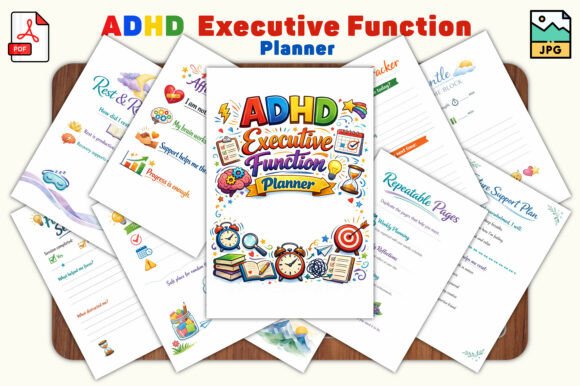
ADHD Executive Function Planner: A Gentle Approach to Focus, Follow-Through, and Self-Compassion
For many adults navigating work, creative projects, or daily responsibilities, the gap between intention and action can feel impossibly wide. You know what needs to be done. You may even want to do it. But something in the process stalls — a fog descends, distractions multiply, and the task stays unfinished. This is executive dysfunction in its most familiar form, and it is not a character flaw. It is a neurological reality that millions of people contend with every day.
Traditional productivity systems rarely account for this reality. They assume linear thinking, consistent motivation, and reliable working memory — precisely the areas where ADHD brains struggle most. The ADHD Executive Function Planner takes a different path. It is not another rigid productivity system demanding adherence to strict schedules. It is a flexible, compassionate tool designed to work with how your brain actually operates, not against it.
Why Executive Function Support Matters More Than Ever
In recent years, awareness of ADHD — particularly in adults — has grown significantly. More professionals, entrepreneurs, creators, and educators are recognizing that their struggles with planning, task initiation, and follow-through are not due to laziness or lack of effort. They are manifestations of executive dysfunction, a core feature of ADHD that affects attention management, time awareness, emotional regulation, and working memory.
At the same time, modern work and life demand more from these cognitive systems than ever before. Remote work requires self-structuring. Creative careers demand sustained focus without external oversight. Entrepreneurship involves juggling dozens of competing priorities with no built-in accountability. Even routine daily tasks can cascade into overwhelm when the brain lacks the scaffolding to break them down and sequence them effectively.
The ADHD Executive Function Planner enters this landscape not as a cure, but as a practical ally. It acknowledges that managing ADHD in adulthood is not about forcing yourself to fit into neurotypical productivity molds. It is about building environments, routines, and tools that genuinely support the way your mind works.
Moving Beyond Rigid Productivity Systems
Many productivity planners on the market share a common flaw: they assume consistent daily energy, reliable time estimation, and strong follow-through. For someone with ADHD, these assumptions can create a cycle of planning, failing to execute, feeling shame, and abandoning the system altogether. The problem is not the person — it is the mismatch between the tool and the brain it serves.
The ADHD Executive Function Planner breaks this cycle by starting with self-awareness rather than rigid scheduling. Its welcome and how-to-use pages orient you gently, setting the expectation that this is a space for progress, not perfection. The planner invites you to check in with your current state before deciding what to do next, a small shift that makes a significant difference for those who struggle with task initiation.
Energy Check-Ins and Daily Intentions
One of the most useful features is the executive function energy check-in. Instead of jumping straight into a to-do list, you first assess where you are: your focus level, your emotional state, your capacity for complex tasks. This simple act of pausing changes everything. It allows you to set a daily intention that aligns with your actual resources, not an idealized version of your day.
From there, top-priority planning becomes realistic rather than overwhelming. You identify one or two meaningful tasks rather than a sprawling list that breeds paralysis. This approach respects the limited bandwidth of working memory and the difficulty of prioritization that many adults with ADHD experience.
Task Breakdown and Task Initiation Support
The planner includes dedicated pages for task breakdown and task-initiation support. This is where the real work happens. Instead of writing "finish report" and hoping for the best, you are guided to break that task into concrete, actionable steps. What is the very first physical action? What comes after that? The structure holds the sequence for you, reducing the cognitive load of holding multiple steps in working memory.
For someone with ADHD, the hardest part of any task is often starting. Task initiation is not a matter of willpower — it is a neurological hurdle that requires external strategies. The ADHD Executive Function Planner addresses this directly by providing a space to define the first step so clearly that it becomes almost impossible not to take it.
Gentle Time-Blocking and Focus Session Logs
Time blindness — the difficulty perceiving the passage of time — is another common challenge. The planner offers gentle time-blocking pages that help you estimate how long tasks actually take, without the pressure of an overly strict schedule. Focus session logs let you track what worked and what didn't, building self-knowledge over time rather than demanding immediate accuracy.
These pages are not about cramming every minute with productivity. They are about developing a realistic relationship with time, one that acknowledges your brain's natural rhythms and distractions are expected, not failures.
Distraction and Working Memory Trackers
Distraction is not a sign of poor discipline. For ADHD brains, it is a constant background hum that requires active management. The planner includes distraction and working memory trackers that serve two purposes. First, they help you notice patterns: When do distractions peak? What environments or tasks trigger them most? Second, they offload the mental burden of trying to remember everything. Writing down a distraction means you can return to it later rather than losing focus entirely.
Working memory support is woven throughout the planner. Brain dump pages provide a safe space to release the clutter of thoughts, worries, and ideas that can otherwise crowd out the day's priorities. Clearing mental space is not a luxury — it is a necessity for anyone whose mind generates constant input.
Emotional Regulation and Self-Compassion Pages
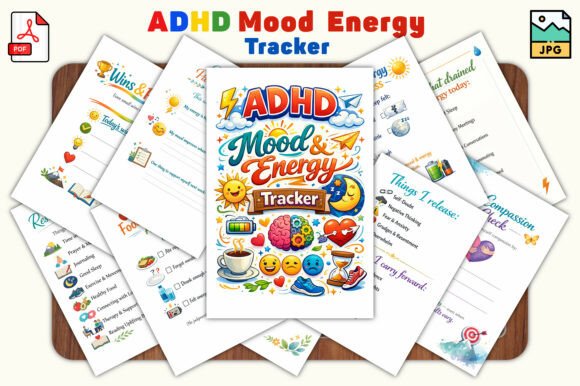
Perhaps the most overlooked aspect of executive function is emotional regulation. ADHD is not just about distractibility; it is also about intense emotional responses, frustration, shame, and overwhelm. The planner includes dedicated pages for emotional regulation and self-compassion, offering a structured way to process feelings without spiraling.
These pages are not about toxic positivity or ignoring real struggles. They invite honest reflection: What am I feeling right now? What do I need in this moment? How can I respond to myself with kindness rather than criticism? For many users, this alone transforms the planner from a productivity tool into a genuine support system.
Wins, Progress, and Weekly Reflection
ADHD brains often struggle to recognize progress. The tendency to focus on what remains undone rather than what has been accomplished is strong. The planner counters this with wins and progress pages, as well as weekly reflection. These sections encourage you to celebrate small victories, notice patterns, and adjust strategies without judgment.
Over time, this builds a more accurate self-view. You begin to see evidence of your own competence, consistency, and growth. The planner becomes a record not just of tasks, but of resilience and learning.
Environment and Tools Reset Pages
Your environment shapes your ability to focus. The planner includes pages for resetting your physical space and digital tools. This could mean clearing your desk, organizing your bookmarks, or adjusting your notification settings. These resets are not about achieving perfect order. They are about creating conditions that reduce friction and support the kind of attention you need for the tasks at hand.
For entrepreneurs, freelancers, and remote workers who manage their own environments, these pages are especially valuable. They serve as regular prompts to evaluate whether your space is helping or hindering your executive function.
Practical Implications for Different Audiences
The ADHD Executive Function Planner is sized at 6×9 inches — compact enough to carry, spacious enough to write freely. Its 30 pages are carefully curated, not overwhelming. For busy professionals, it fits into a bag and can be used during breaks, meetings, or morning routines. For creators and entrepreneurs, it provides structure without stifling creativity. For educators and freelancers, it offers the flexibility to adapt to ever-changing schedules.
What makes this planner particularly effective is its emphasis on compassion over discipline. It does not assume you will use it perfectly every day. It assumes some days will be hard, and that is okay. The pages are designed to meet you where you are, not where you think you should be.
A Tool That Evolves With You
Because the planner focuses on self-awareness and reflection, it naturally adapts to changing needs. What works during a high-energy week may shift during a low-energy one. The check-ins and log pages help you notice these shifts and adjust accordingly. Over months of use, you build a personalized understanding of your own executive function patterns — something no generic planner can offer.
The ADHD Executive Function Planner is not a quick fix. Executive dysfunction does not disappear overnight. But with consistent, compassionate use, this planner becomes a reliable scaffold for planning, focus, memory, and follow-through. It helps reduce overwhelm, supports emotional regulation, and makes the gap between intention and action a little narrower each day.
For anyone who has tried rigid systems and felt like a failure, this gentle alternative offers something more valuable than productivity tips. It offers a way to work with your brain, build genuine self-trust, and move forward — one small, manageable step at a time.